
Capture It: Your Best Person Is a Single Point of Failure and Nobody Has Written Anything Down
This is the step every packaging owner agrees with and almost nobody does. It stays on the list for years, and then one day the man retires and the thing everybody agreed about becomes the thing everybody regrets.
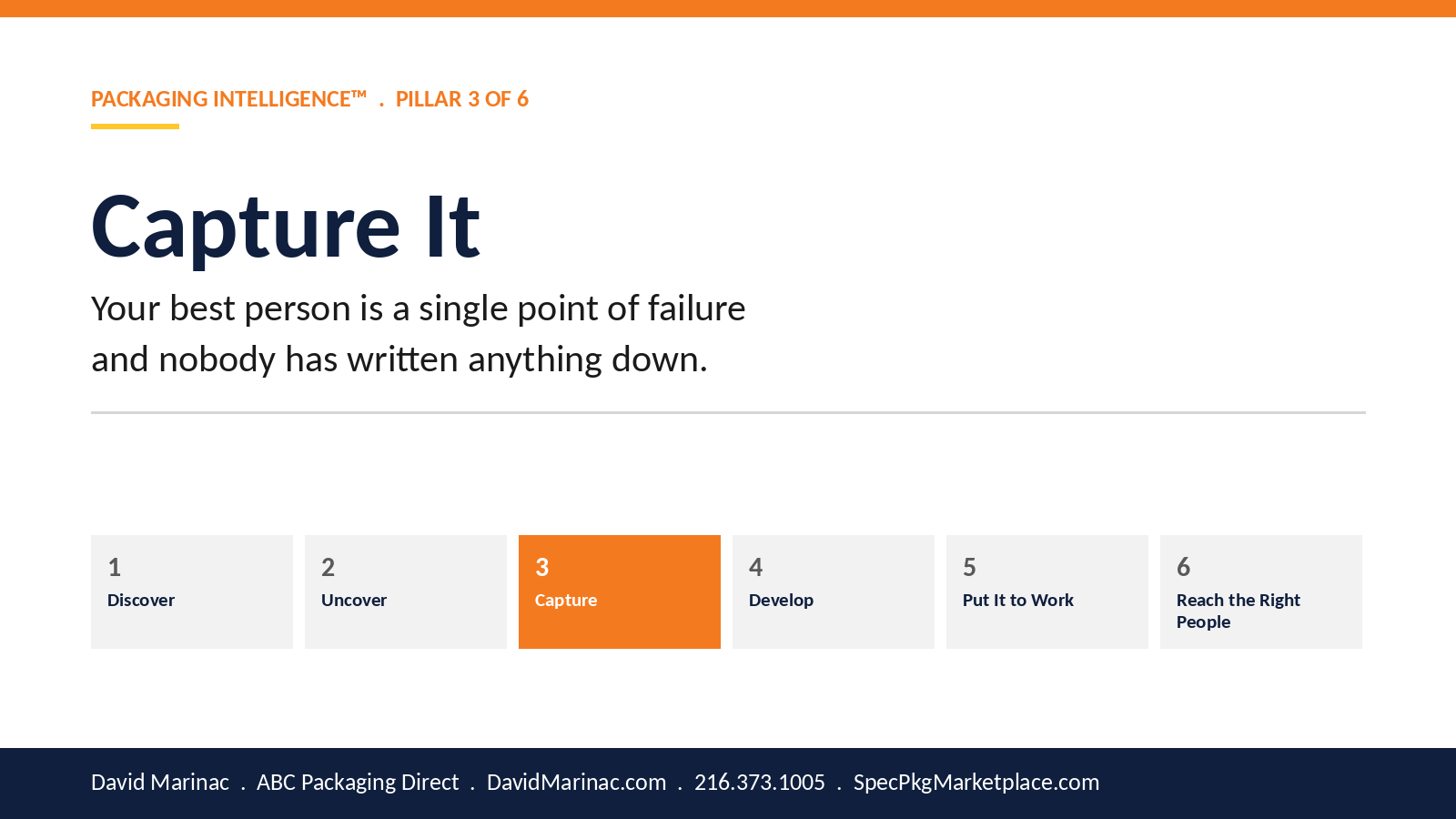
Packaging Intelligence is the practice of capturing a packaging company's niche expertise and organizing it so the company can find and win more of its best-fit customers.
There is a man in your company who knows more about one specific thing than almost anyone alive. He is probably somewhere in his late fifties or sixties. He has been doing this since before the equipment on your floor was installed.
Now answer honestly. If he did not come in on Monday, what would you lose?
Not his hours. Not his accounts. The other thing. The judgment. The instant read on a sample. The reason he knows a spec is wrong before anyone runs it. The four hundred small corrections he has made over thirty years that never got explained to anybody, because nobody ever asked him to explain them.
Most owners, asked that question, do the math for a second and then change the subject. It is an uncomfortable number and there is no line for it on the P and L. So it sits there, uninsured, and everybody hopes.
The step everyone agrees with and nobody does
Nobody argues about capture. Every owner I have ever raised it with nods along. Of course we should get that written down. We have talked about it. It is on the list.
It has been on the list for eleven years.
It stays on the list because of how it gets framed. The moment somebody calls it documentation, it becomes a project. A project needs a plan, an owner, and a budget, and there is no urgency attached to any of it because the man is right there at his desk.
Then one day he is not.
Uncover told you what to go get. Capture is going and getting it.
Uncover produced an inventory. A ranked list of the things your company knows that nobody else does.
That list is useful and it is also worthless on its own, because it names the knowledge without containing it. It is a table of contents for a book that has not been written.
Capture is the step where the knowledge itself comes out of the head and into something durable. Recorded, transcribed, stored, and yours whether the man stays or not.
It is not writing. That distinction is the entire reason this step fails or works.
Five rules for a capture session
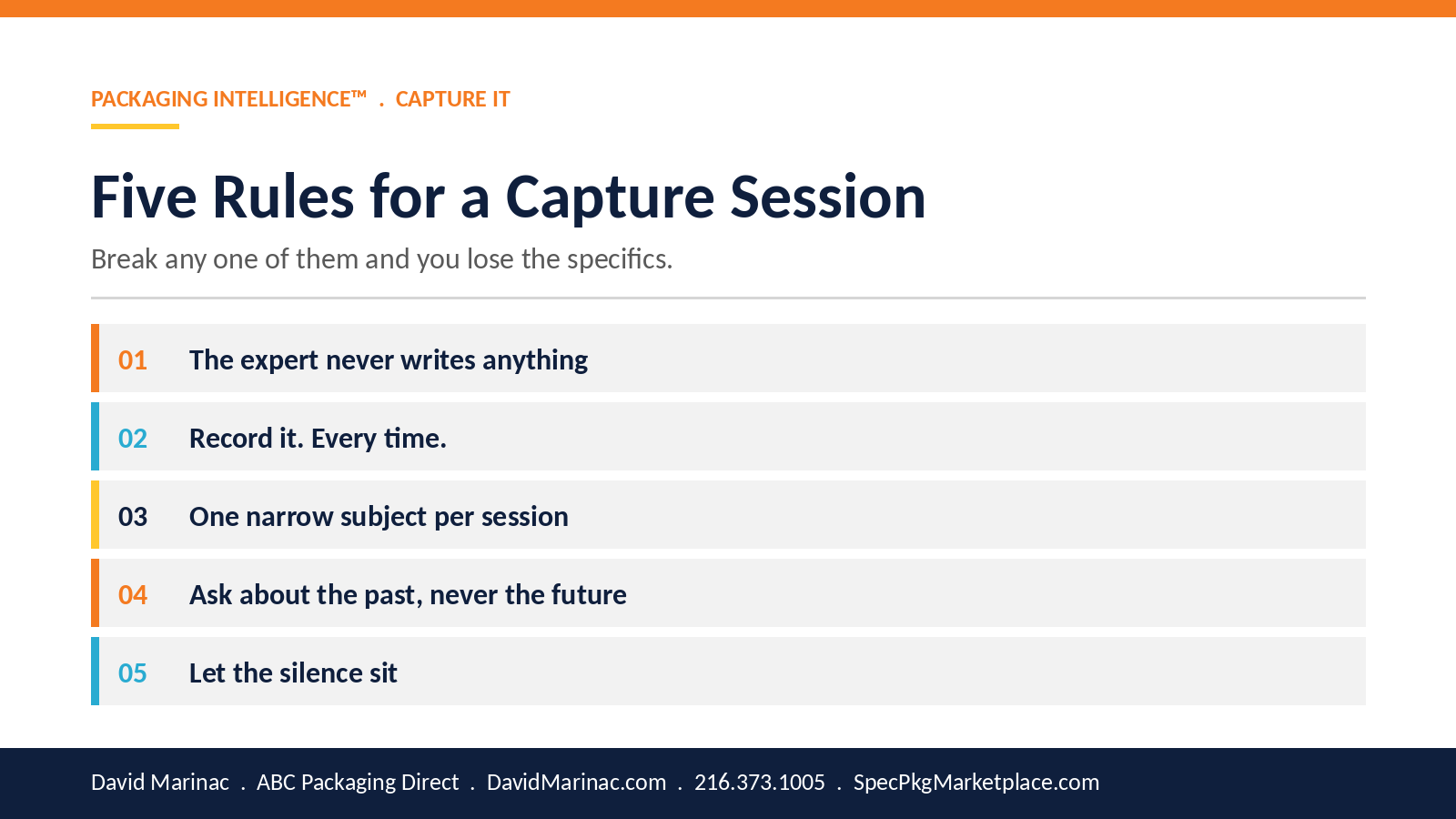
1. The expert never writes anything
Hand a veteran a writing assignment and one of two things happens. He does not do it, or he does it badly, because writing is a separate skill he was never hired for and does not enjoy.
Worse, the act of writing makes him formal. He starts producing capabilities language. The man who would have told you a great story at a bar hands in three paragraphs that sound like a brochure.
He talks. Somebody else handles everything after that. Tell him this out loud at the start, because half of what makes people avoid these sessions is the fear that homework is coming.
2. Record it. Every time.
Not notes. Notes are a summary of the interesting parts as judged by whoever was listening, which means the detail he threw away in half a sentence is gone.
Record the session. Video if you can, audio at minimum. The recording is the source of truth, and everything downstream is a transcript of it.
That order matters more than it looks. It means the finished piece can always be traced back to a real person saying a real thing on a real day, and that is the strongest authenticity signal available to anybody.
3. One narrow subject per session
Tell me everything you know is not a question. It is a wall. Nobody can answer it and most people freeze.
Pick one item off the Uncover list. One failure mode. One application. One kind of customer. Forty five minutes on something that specifically produces more usable material than a whole day of general reminiscing.
4. Ask about the past, never the future
What do you think buyers will want gets you an opinion, and his opinion is not the asset.
Tell me about the last time this went wrong gets you a story with a year in it, a customer in it, and a specific decision in it.
Memory is precise. Speculation is vague. Always ask him to remember, never to predict.
5. Let the silence sit
This is the one people cannot do. He gives you a short answer, there is a pause, the pause feels awkward, so the interviewer jumps in with the next question.
That pause is where the real answer lives. Wait through it. Count to ten if you have to. What comes out on the other side usually starts with well, the thing nobody understands is, and that is the sentence you came for.
Who should be in the room
Two people, not five. The expert, and one interviewer who knows enough about the industry to ask the second question.
That last part gets underestimated. Anybody can ask the first question off a list. The value is entirely in the follow up, and you cannot follow up on something you did not understand. An interviewer with no working knowledge of the field will let the most important sentence of the hour go straight past him, because it sounded like a technicality.
Do not put the boss in the room if the boss is the one being captured. And do not turn it into a group session. Add a third person and the expert starts performing for the audience instead of talking to one person, and performance is the enemy of specifics.
What a session actually produces
A recording, a transcript, and about eight usable things you did not know were in there.
It does not produce a draft. It does not produce a page.
It should not be cleaned up, polished, or made presentable at this stage, and the temptation to do that is the single most common way good material gets ruined. The messy version has the year in it, the customer, the number, the moment he realized what was wrong. The tidy version has none of that, because tidying is mostly the removal of specifics.
Shaping it for a buyer is Develop. Leave it raw until then.
Cadence beats intensity
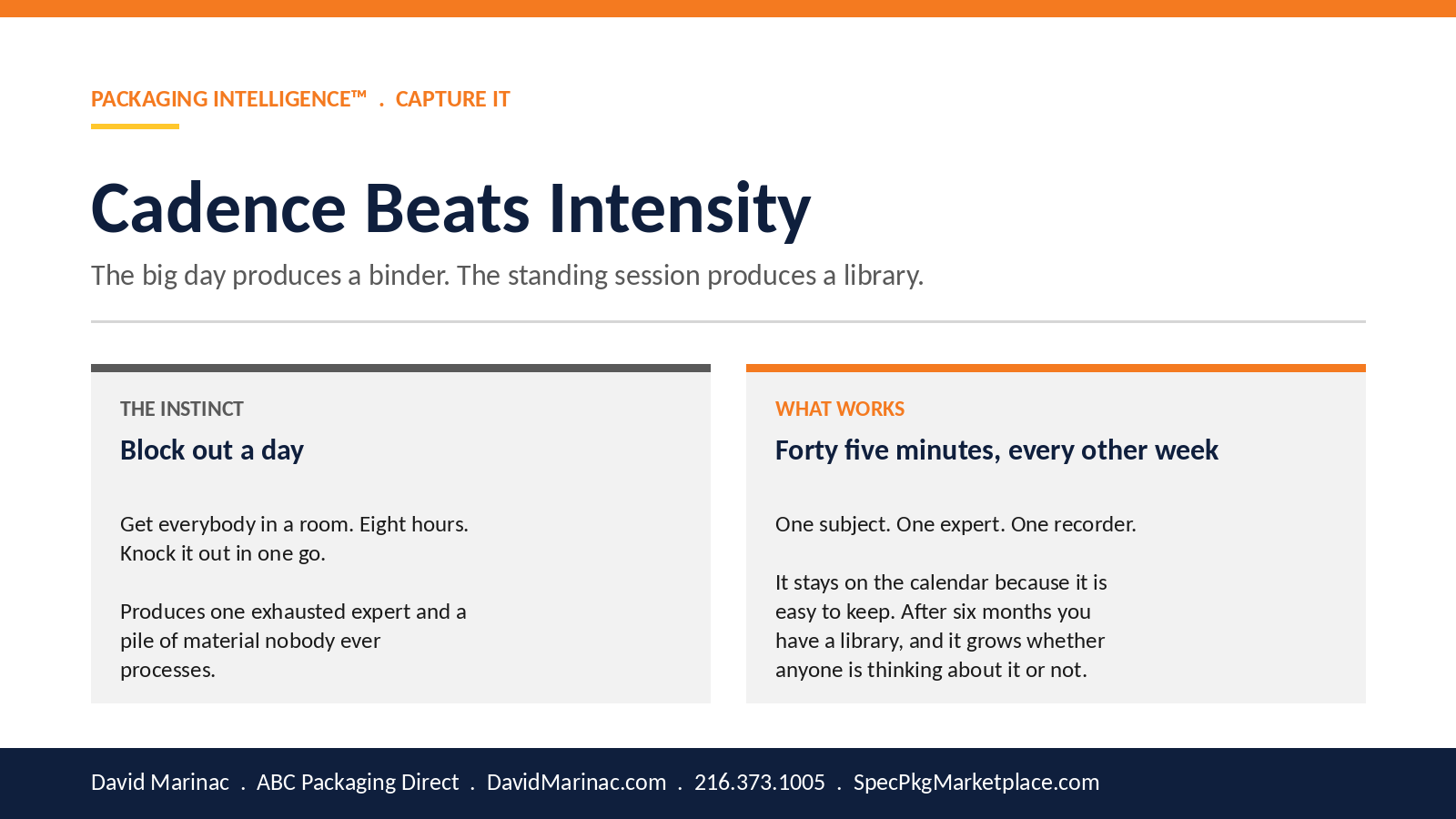
The instinct is to schedule a big day. Get everyone in a room, block out eight hours, knock it out. That produces one exhausted expert and a pile of material nobody ever processes.
What works is small and repeated. Forty five minutes, one subject, every other week.
It stays on the calendar because it is easy to keep, and after six months you have a library instead of a binder. The compounding is the point. A single session is a nice conversation. A standing session is an asset that grows whether anyone is thinking about it or not.
The clock nobody wants to look at
There is a commercial reason to do this, and it belongs to the next step, because Develop is where captured knowledge turns into buyers finding you.
Capture has its own reason and it is not commercial.
This industry is old, and the people who know the most in it are mostly on the back nine. Their knowledge exists in no document, has no successor, and is not backed up anywhere. Every quarter that passes without capture is a bet that nothing changes.
You would not run the plant with one machine, no spare parts, and no service contract. That is exactly how most companies are running their expertise.
The one thing to do this week
Put forty five minutes on the calendar with your best person. Pick one item off the list you made in Uncover. Turn on a recorder and tell him you are not going to ask him to write anything, ever.
Then ask him about the last time it went wrong, and be quiet.
At the end of that forty five minutes you will own something your company has never owned before. It is not a plan to capture your expertise. It is the first piece of it, on file.
LINK: What Is Packaging Intelligence?
LINK: Discover Packaging Intelligence
LINK: Uncover Packaging Intelligence
LINK: Develop Packaging Intelligence
LINK: Packaging Intelligence FAQs
LINK: Packaging Intelligence Glossary
LINK: Reach the Right People
LINK: Put Packaging Intelligence to Work
Go deeper on Capture: Consider...
Why your expert should never be asked to write anything?
The recording is the source of truth: why notes are not enough?
How to run a forty five minute capture session?
Ask about the past, never the future.
What to do with a transcript once you have one?
START WITH YOUR OWN COMPANY: Click Here to Schedule Your Own Packaging Intelligence Audit
Find what makes you irreplaceable
If you run a packaging company and there is knowledge in one head and nowhere else, start with the Packaging Intelligence Audit. A straight read on where your expertise is trapped and where your best buyers are already looking.
David Marinac . ABC Packaging Direct . DavidMarinac.com . 216.373.1005 . SpecPkgMarketplace.com
PREVIOUS AND NEXT PILLAR LINKS
Previous: Uncover It. The most valuable thing you know is the thing you think is obvious.
Next: Develop It. Turning raw material into something a buyer can read and a machine can quote.
VIDEO



Ready to find your packaging partner?
Join hundreds of manufacturers and buyers already using PackageLink to streamline their sourcing process.