
Reach the Right People: You Are Sending Your Best Thinking to Someone Whose Job Is to Lower the Number
The last of the six steps, and the one everybody tries to do first. Outreach in this industry does not have a channel problem. It has an aim problem, and an arriving-empty-handed problem.
Packaging Intelligence is the practice of capturing a packaging company's niche expertise and organizing it so the company can find and win more of its best-fit customers.
A company sends the best thing it has ever written to a purchasing coordinator.
He does not read it. Not because it is bad. Because he is not in any pain. His job is the number, he is measured on the number, and his bonus is attached to the number. You sent a thoughtful explanation of a technical failure mode to a man whose entire role is to make your quote smaller.
Then everybody concludes that outreach does not work in this industry.
Outreach works fine. It was aimed at the wrong person.
Pain is the qualifier, not title
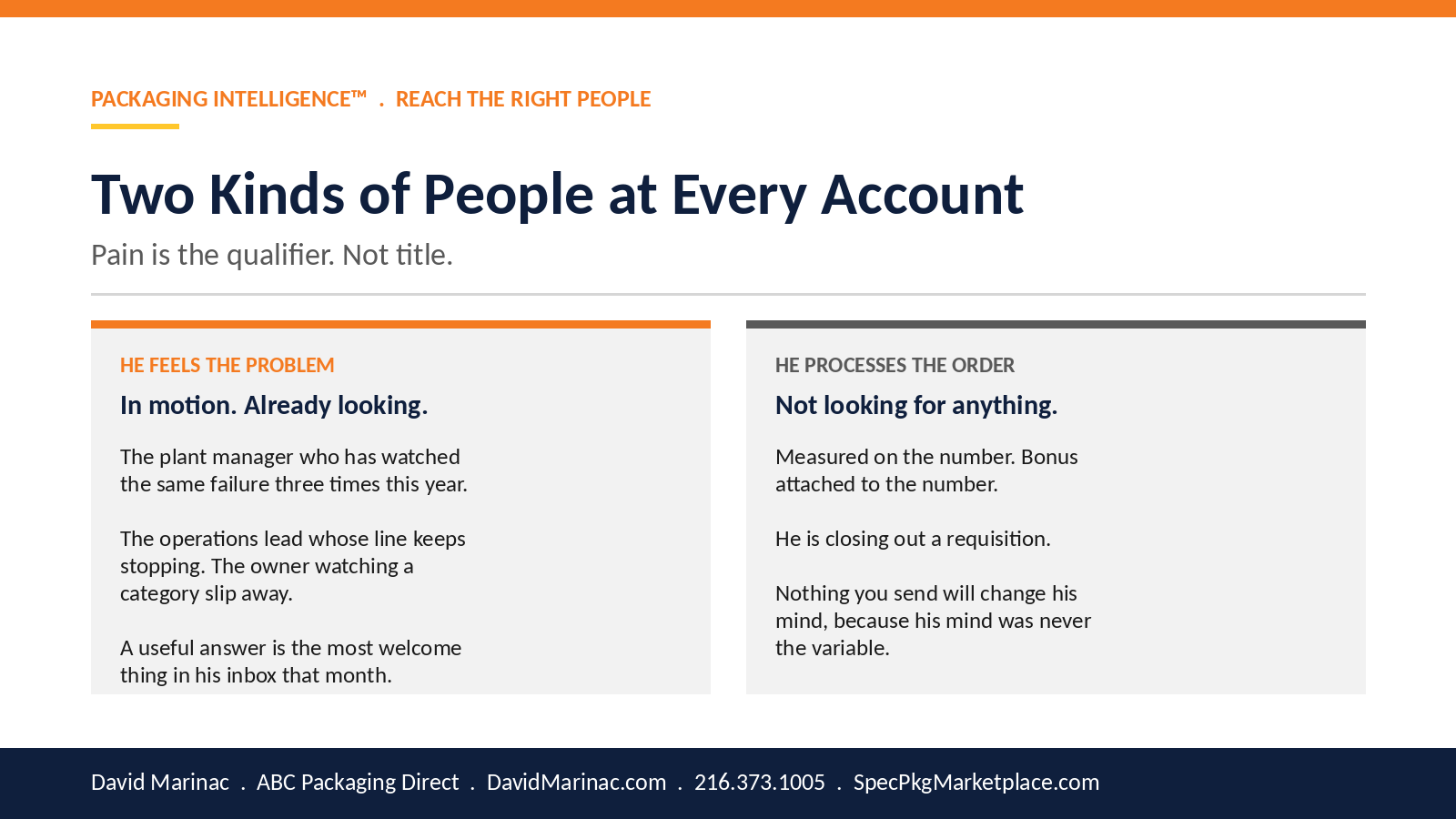
There are two kinds of people at every company you want. The ones who feel the problem and the ones who process the order.
The one who feels it is having a bad quarter because of it. He is the plant manager who has watched the same failure three times this year. The operations lead whose line keeps stopping. The R and D person who cannot get a formulation to survive distribution. The owner who is watching a category slip away and does not know why.
Those people are in motion. They are already looking for an answer, and a genuinely useful explanation of their exact problem is the most welcome thing that will hit their inbox that month.
The one who processes the order is not looking for anything. He is closing out a requisition. Nothing you send him will change his mind, because his mind was never the variable.
This is not a criticism of purchasing. He is doing the job he was given, correctly, and he is measured on saving money. The executive who absorbs a recall or a compliance problem is measured on something else entirely. Those two rooms almost never connect, and the whole game here is reaching the second one.
Sell to pain. Everything else is a coin flip.
Start from your best customer, not from a filter
The instinct is to buy a list. Pick an industry code, set a revenue band, pull two thousand names, start sending. It feels like progress because the number is big.
Do it the other way around.
Look at your single best account. Not the biggest one, the best one. The one where the work suits you, the margin is honest, the people are reasonable, and if you lost it you would be genuinely upset.
Then answer some questions about it. What is actually true of that company? What problem were they in when they found you? Who inside made the decision, and what was he worried about. Why has it lasted?
Now go find twenty five more that look like that.
Twenty five is not a small ambition. Twenty five accounts that look like your best account would change most packaging companies permanently. And a list of twenty five that you built by hand beats a list of two thousand you bought, every time, because you can actually be specific with twenty five.
What you send
Something useful about a problem they have. That is the whole rule.
Not an introduction to your company. Not a capabilities overview. Not a request for fifteen minutes so you can learn about their needs, which every serious person reads as fifteen minutes so I can pitch you.
You spent four steps building material that is specific, honest, and genuinely hard to get anywhere else. That material is the reason to make contact. It arrives as a gift instead of a request, and it does something no introduction can do. It proves the claim in the act of making it. A man who reads your explanation of the failure he is living with does not need to be told that you understand his problem.
This is also why the order of these six steps matters. Reaching out with nothing to say is the position most companies are in, and it is why outreach in this industry has such a bad reputation. It is not that the channel is dead. It is that everybody is arriving empty handed.
Four ways this goes wrong
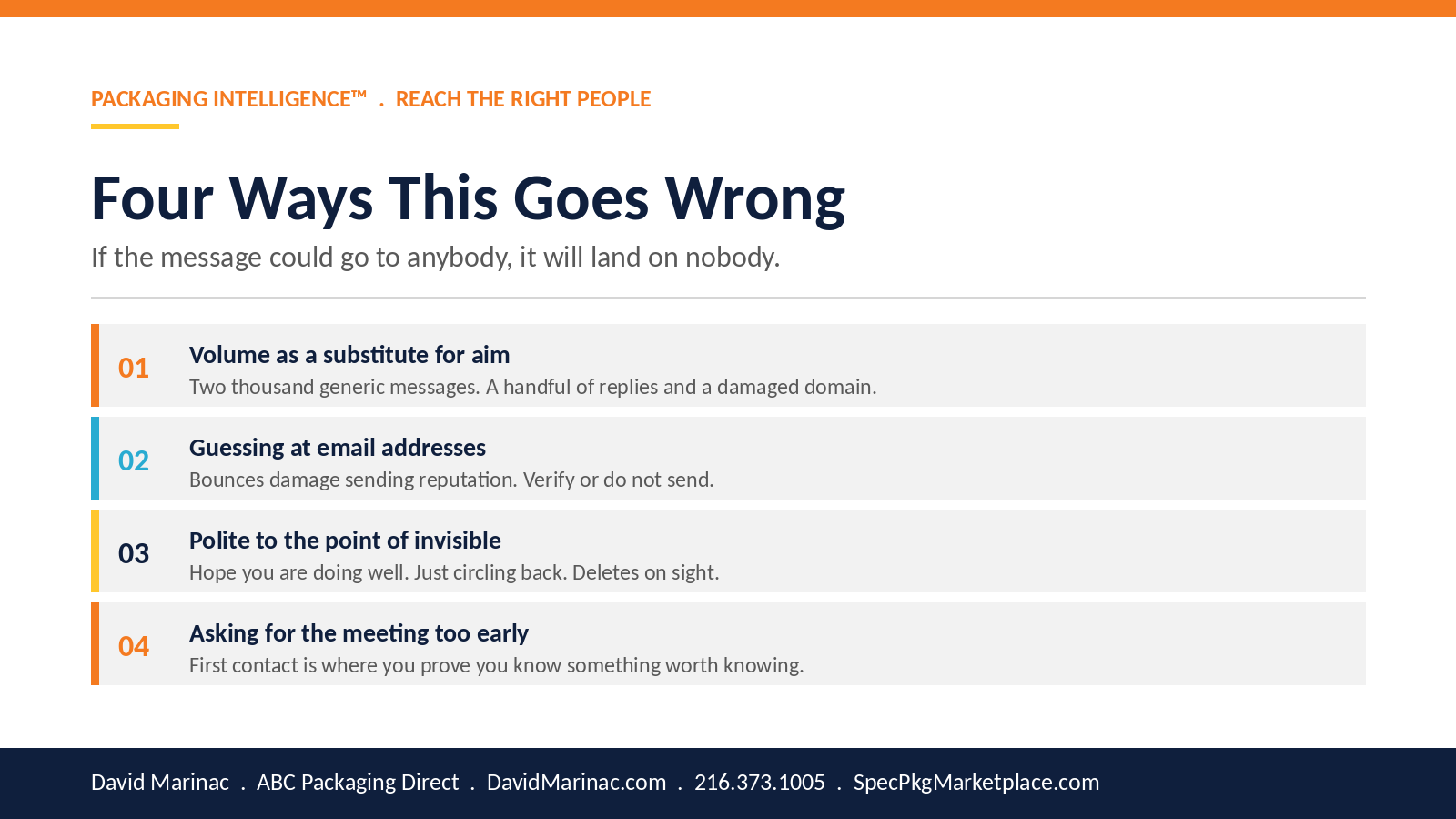
1. Volume as a substitute for aim
Two thousand generic messages will get you a handful of replies and a damaged domain. Twenty five specific ones will get you conversations.
If the message could go to anybody, it will land on nobody.
2. Guessing at email addresses
Pattern guessing produces bounces. Bounces damage your sending reputation. A damaged reputation quietly kills the mail your actual customers were supposed to receive, and you will not find out for months.
Verify or do not send. This is the least glamorous rule here and the most expensive one to break.
3. Polite to the point of invisible
Hope you are doing well. I just wanted to reach out. Thought I would circle back. All of it deletes on sight.
A busy man gives you one line to prove you are worth the next one. Say the true, slightly uncomfortable thing instead. Being ignored is the only real failure, and being agreeable is the most common way to earn it.
4. Asking for the meeting before you have earned it
The first contact is not where you close. It is where you demonstrate that you know something worth knowing.
Ask for very little, offer something real, and let the value do the work that pressure cannot.
Both directions at once
Do not read this as a choice between being found and going out.
Being found handles the buyers you will never identify. He is at his desk at ten at night, three weeks into a problem, typing a full question and reading the answer. You cannot make a list of that man. He finds you or he does not.
Going out handles the ones you already know you want. The twenty five. They are not searching today, and they may not be for two years, but you know exactly who they are.
Same material, both directions. That is the leverage. Everything you built in the first five steps works standing still and works in motion, and most companies run only one of those and wonder why it feels like pushing a car.
Where the series lands
Six steps.
Discover that you own something and find where it hides. Uncover what you actually know that nobody else does. Capture it before it walks out the door. Develop it into something a buyer can use. Put it to work inside the selling you already do. Reach the people who feel the pain.
Then it starts again, because the next niche is sitting there empty, and because every engagement teaches you something worth capturing about the one you just finished.
None of this is a campaign. A campaign ends. This is an asset, and the difference is that it is worth more in year three than in year one, which is the opposite of nearly everything else a packaging company spends money on.
The one thing to do this week
Write down the name of your best customer. One name.
Then write down five companies that look like that one. Not a list. Five names, by hand, from what you already know about your own market.
That is the beginning of the only list that has ever been worth anything, and you did not have to buy it.
CLICK HERE AND START WITH YOUR OWN COMPANY–Pkg Intelligence Audit
Find what makes you irreplaceable?
Bring your best customer and we will talk about why he is your best customer, and who else looks like him. Start with the Packaging Intelligence Audit. A straight read on where your expertise is trapped and where your best buyers are already looking.
LINK: What Is Packaging Intelligence?
LINK: Discover Packaging Intelligence
LINK: Uncover Packaging Intelligence
LINK: Capture Packaging Intelligence
LINK: Develop Packaging Intelligence
LINK: Packaging Intelligence FAQs
LINK: Packaging Intelligence Glossary
LINK: Put Packaging Intelligence to Work
PREVIOUS PILLAR LINK AND SERIES CLOSE
Previous: Put It to Work. Most companies publish the thing and then never use it again.
Start the series from the beginning: Discover It. The most valuable asset your packaging company owns is invisible.
VIDEO



Ready to find your packaging partner?
Join hundreds of manufacturers and buyers already using PackageLink to streamline their sourcing process.