
Aseptic Bag-in-Box: The Questions Buyers Actually Ask
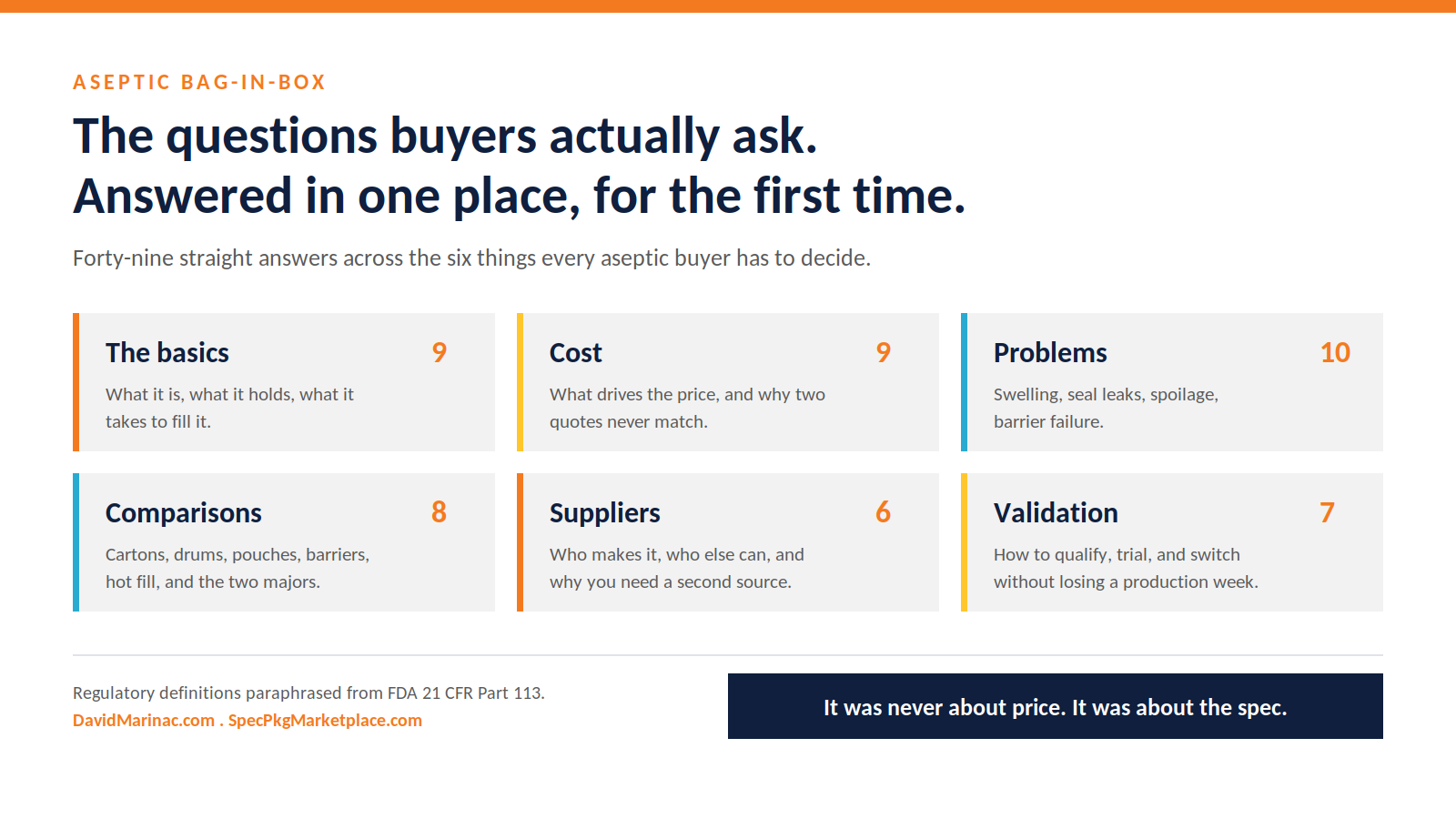
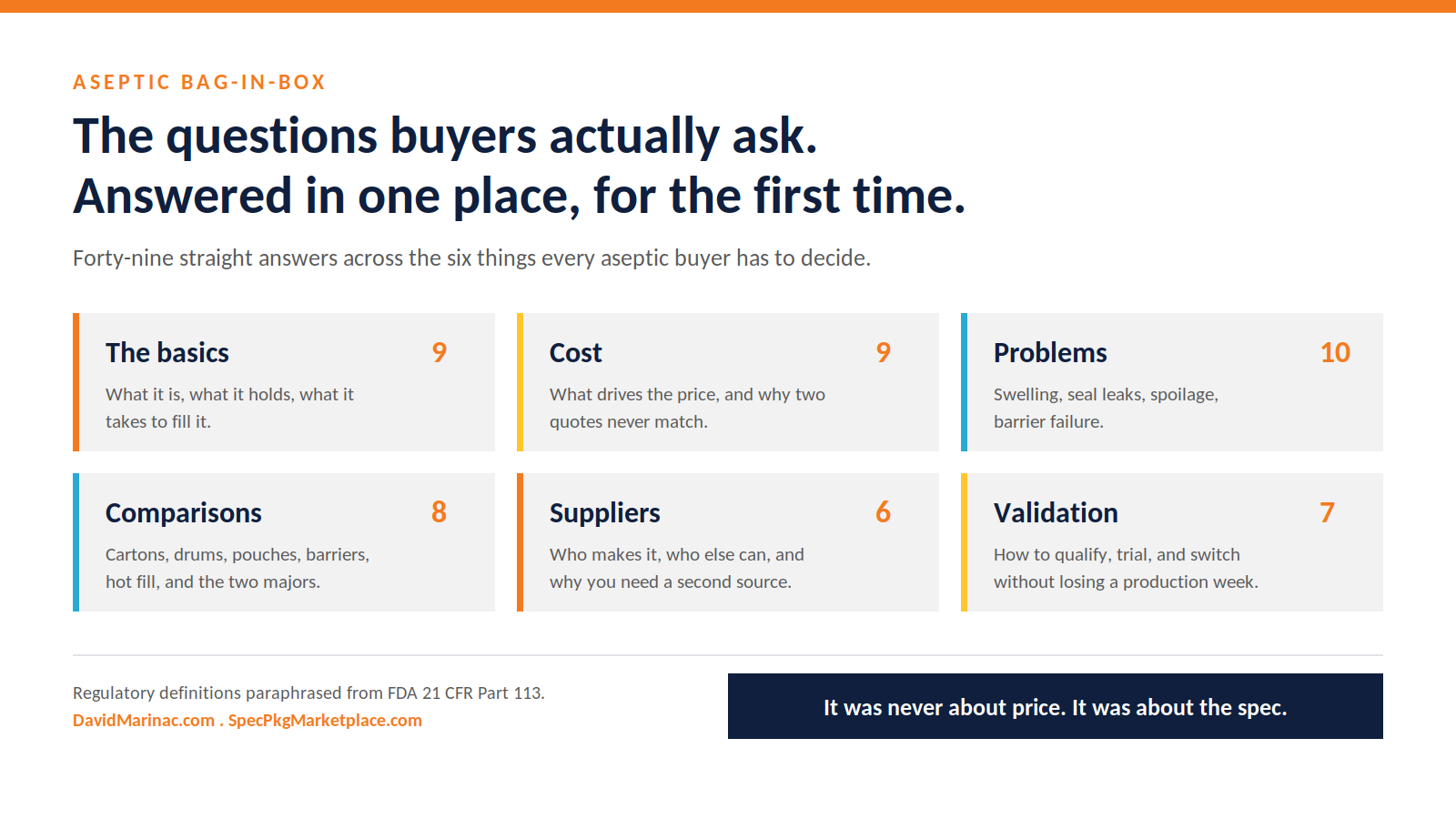
Cost, failures, suppliers, switching, and validation. Forty-nine straight answers about aseptic bag-in-box, written for the person who has to make the decision and live with it.
Most of what is published about aseptic bag-in-box is written by companies that sell filling equipment or by the two suppliers who dominate North America. That leaves the buyer with brochures on one side and silence on the other. The questions that actually keep a plant manager or a packaging director up at night, why a bag swelled, what a quote really includes, whether a second source is worth the risk, are the ones nobody answers in plain language.
This page answers them. No brochure, no pitch inside every sentence. Where the honest answer is that it depends, we say what it depends on. Where there is a federal rule behind the answer, we point at the rule.
The questions are grouped six ways. The basics. Cost. Problems and failures. Comparisons. Suppliers and selection. Validation and switching.
The basics
What is aseptic bag-in-box?
Aseptic bag-in-box is a two-part package. A multi-layer flexible bag with a fitment, sitting inside a corrugated box that carries and protects it. The product is commercially sterilized, cooled, and filled into a bag that has already been sterilized, then sealed in an environment free of microorganisms. The result is a shelf stable liquid that needs no refrigeration and no preservatives to stay safe.
Is aseptic bag-in-box shelf stable without refrigeration?
Yes, when the process is done correctly. Federal regulation defines the target as commercial sterility, which means the product is free of microorganisms that could reproduce under normal non-refrigerated storage and free of viable microorganisms of public health significance. That is the legal definition of what shelf stable actually means. If a bag fails in the field, what failed is either that sterility or the hermetic seal that was supposed to protect it.
How much shelf life does an aseptic bag-in-box add?
For most liquid products the working range is six to twelve months at ambient temperature, and some products run longer. The gain over refrigerated formats is often dramatic. A cold brew coffee product that ran sixty days refrigerated can move to roughly nine months shelf stable in an aseptic format. Your actual number depends on the product chemistry, the barrier structure, and the storage conditions, and it should be confirmed by shelf-life testing rather than assumed.
What products can be packaged in an aseptic bag-in-box?
Liquids and pumpable products across four broad families. Beverages, including juice, cold brew, smoothies, nutritional drinks, and plant-based and alt-dairy. Dairy, including milk, cream, and dairy bases. Food, including tomato and fruit purees, sauces, soups, broths, liquid egg, and baby food. And industrial and specialty liquids such as bulk oils and concentrates. Products with large particulates are the hardest fit and need to be evaluated case by case.
What sizes does aseptic bag-in-box come in?
The range runs from roughly three liter retail and foodservice sizes up through the common bulk formats at 220 liter, which is drum equivalent, and 1000 liter, which is tote equivalent. Between those sit the five, ten, and twenty liter foodservice sizes that dominate restaurant and institutional supply. Size drives the fitment, the film structure, and the handling equipment, so it is the first spec decision, not a late one.
What is inside an aseptic bag, and why are there multiple layers?
An aseptic bag is a laminate, not a single film. Each layer does one job. An inner layer that is food contact safe and seals cleanly. A barrier layer that keeps oxygen out, usually EVOH, metallized film, or foil. And outer layers that provide strength and abuse resistance through filling, shipping, and dispensing. Bags are described as single web or multi-ply depending on how many of these structures are stacked, and the count is one of the biggest cost drivers in a quote.
Do I need special equipment to fill aseptic bag-in-box?
Yes. Aseptic filling requires a sterilizer and holding tube that bring the product to commercial sterility, a cooling stage, and an aseptic filler that sterilizes the bag and fitment before filling and seals it in a sterile zone. This is not equipment you retrofit onto a standard line. The two practical paths are buying an aseptic line or using a co-packer that already has one.
What is the difference between aseptic filling and extended shelf life filling?
Aseptic filling targets commercial sterility in both the product and the package, which is what allows ambient storage. Extended shelf life, or ESL, uses a lighter thermal process and clean rather than sterile filling. It buys added refrigerated shelf life, not shelf stability. If your product still needs a cold chain, you have ESL, not aseptic, and the freight and distribution economics are completely different.
Can an aseptic bag-in-box be recycled?
Partly, and honestly this is the weakest point in the format. The corrugated box recycles through normal channels and represents most of the package weight. The bag itself is a multi-material laminate, which makes it difficult to recycle in most curbside systems, though it uses far less material than the rigid packaging it replaces. Anyone who tells you the whole package is fully recyclable today is overselling it.
Cost
How much does an aseptic bag-in-box cost per unit?
There is no single number, and any supplier who quotes one before seeing your spec is guessing. Per-unit cost is set by size, film structure, barrier type, fitment, and order volume, and those five variables can move a quote by a wide margin for what looks like the same bag. The useful question is not what it costs, it is what am I being quoted on. Two quotes that look far apart are almost always two different specs.
What actually drives the price of an aseptic bag?
Four things, in order of impact. The film structure and number of plies. The barrier layer, since a high-barrier film for dairy or a sensitive juice costs more than a basic structure. The fitment, because connector style and quality vary widely. And volume, where minimum order quantities and run length move the per-unit price more than buyers expect. That is the part nobody explains, and it is why quote comparison in this niche is so often apples to oranges.
How does cost change by size?
Cost per liter generally falls as size rises, which is why bulk formats at 220 and 1000 liter carry the strongest economics for anyone shipping volume. Retail and small foodservice sizes carry more film and more fitment per liter of product, so they cost more per liter and are chosen for the channel, not for the cost. The right comparison is always cost per liter delivered, not cost per bag.
What is a typical minimum order quantity, and how much does it move the price?
MOQs in this niche are set by the converting run, so they are usually meaningful, and they move price more than most buyers anticipate. A small trial order and a full production run are not on the same price curve. If your volume sits below a supplier's comfortable run length, expect either a premium or a polite decline, and treat that as useful information about whether the fit is right.
What is the real cost difference between filling in-house and using a co-packer?
A co-packer converts a capital decision into a per-unit cost. You pay more per unit and no capital, and you accept scheduling and control trade-offs. An in-house line costs significant capital and commits you to volume, but the per-unit cost drops substantially and you control the schedule. The crossover is a volume question, and the honest way to run it is over a multi-year horizon including labor, maintenance, validation, and downtime, not just equipment price divided by units.
What does aseptic filling equipment cost if we bring it in-house?
Enough that it is a board-level decision, and the range is wide depending on speed, format, and whether you are buying a modular system or a full line. The equipment quote is also not the real number. Add installation, utilities, validation, process authority work, operator training under an FDA-approved school requirement, and the production you lose during commissioning. Get those on the same page as the equipment number before you compare it to a co-packer.
How does aseptic bag-in-box cost compare to aseptic cartons?
Bag-in-box generally wins on cost per liter at larger volumes and on flexibility, since it does not tie you to a single supplier's proprietary filling system in the same way. Cartons win on retail shelf presence and single-serve formats. The bigger difference is strategic. Carton systems tend to lock the format, the machine, and the supply into one relationship, and bag-in-box does not have to.
What hidden costs show up when you switch suppliers?
Four that buyers routinely miss. Qualification and validation work on the new material. Filler and fitment compatibility changes, which can mean changing parts or adjustments. Parallel inventory carried during the transition. And the cost of any run that does not go cleanly while the new spec is dialed in. A switch that looks like a small per-unit saving can be net negative in year one if these are not priced in.
How are resin pricing and tariffs affecting cost?
Resin is the base input for the film, so resin markets move bag pricing with a lag, and trade policy on imported film and finished bags adds a second variable. This is a live and changing picture rather than a fixed number, which is why long-term agreements in this niche often include an index or a review mechanism. Ask any supplier how their pricing responds to resin movement before you sign, not after.
Problems and failures
Why is my aseptic bag swelling or ballooning?
Swelling almost always means gas, and gas almost always means the sterile barrier was broken somewhere. The three usual causes are a seal that did not fully form during filling, a barrier film that is letting oxygen in, or a fitment that did not seat correctly. The fastest way to tell them apart is where and when it shows up. A fill problem tends to be random across a run. A film or fitment problem tends to track to a lot or a batch of bags.
What causes seal leaks?
Seals fail for a small number of repeatable reasons. Contamination in the seal area from product splash during filling. Incorrect seal temperature, pressure, or dwell time on the filler. A film structure whose sealant layer does not match the process. Or physical abuse after filling that stresses a seal that was marginal to begin with. Leaks that cluster at one point in a run point to the filler. Leaks scattered across lots point to the material.
Why is my product spoiling in a bag that is supposed to be shelf stable?
Shelf stable is a claim about a validated process, not a property of the bag. Spoilage means commercial sterility was not achieved or not maintained. Either the product side of the process fell short, the container and fitment were not fully sterilized before filling, or the hermetic seal was compromised afterward. The regulation is explicit that if packaging conditions drop below the scheduled process, the affected product must be stopped, diverted, or segregated. Your investigation should follow that same path.
What causes oxygen ingress and barrier failure?
Three things, usually. The wrong barrier for the product, meaning the oxygen transmission rate of the chosen structure is too high for the sensitivity and intended shelf life. Damage to the barrier layer through flex cracking or abuse in handling and shipping. Or ingress at the fitment rather than through the film, which is a common and often missed path. Barrier is a system property, film plus fitment plus seal, not a film spec alone.
Why do my fitments and spouts leak?
Most fitment leaks trace to one of three causes. A seating or insertion problem during filling, where the fitment is not fully welded to the film. A mismatch between the fitment and the filler or the connector on the receiving end. Or a dimensional variation in the fitment itself across lots. This is the reason fitment and connector type is a spec line worth arguing over, not a detail to leave to the supplier.
How do I tell a film problem from a fill problem when a bag fails?
Pattern and traceability. Pull the failures and map them against the fill run and against the bag lot. Failures that spread randomly across a production run, regardless of bag lot, point at the filler and the process. Failures that concentrate inside one bag lot, across multiple fill runs, point at the material. Do this before the phone call, and the conversation with your supplier stops being an argument and becomes an investigation.
What shortens the shelf life of an aseptic product?
Warehouse temperature above the assumed storage condition. A barrier structure that was specified for a less demanding product. Light exposure for sensitive products. Handling abuse that flex-cracks the barrier. And headspace or fill weight variation, which the regulation treats as a critical factor because it can affect whether the scheduled process actually delivered. Shelf life is a system outcome, and a bag stored in a hot dock in August is not the bag you tested.
What happens when the barrier film is wrong for my product?
Acidic products, dairy, high-fat products, and particulates each stress a different part of the structure. A high-acid juice can attack a structure specified for something milder. Dairy and low-acid products carry more microbiological risk and more regulatory weight, because low-acid is legally defined as a finished equilibrium pH above 4.6 with water activity above 0.85. Particulates abrade. Specify the barrier against the product chemistry, not against the price.
Why did my new supplier's bags fail when the old ones did not?
Almost always a spec difference that was not visible in the quote. A different sealant layer that needs different filler settings. A fitment with slightly different dimensions or weld characteristics. A barrier structure that is nominally equivalent but performs differently under your conditions. This is exactly why a supplier change is a qualification project and not a purchase order, and it is the single most common expensive lesson in this niche.
How do I prevent failures, and what should the spec actually say?
Write the spec so it can be verified, not just quoted. Name the film structure and ply count, the barrier type and the oxygen transmission rate target, the fitment make and model, the seal parameters, and the acceptance criteria for incoming lots. Then require certificates and lot traceability against it. A spec that says aseptic bag, 220 liter, is not a spec. It is a hope.
Comparisons
Aseptic bag-in-box versus aseptic carton, which is right?
Cartons are built for retail shelf and single-serve. Bag-in-box is built for foodservice, industrial, and bulk transfer, and it dominates the larger volumes. The cost comparison favors bag-in-box as volume rises. The strategic comparison matters more. Carton systems tend to bind the format, the filling machine, and the supply into one relationship, and bag-in-box leaves you more room to hold a second source.
Bag-in-box versus drums and totes for bulk liquid?
Bag-in-box wins on empty weight, on return logistics since there is nothing to send back and clean, and on product protection through a sterile single-use liner. Drums and totes win where the receiving operation is already built around them, where the product is aggressive or hot filled, or where reuse economics are strong. The freight and cleaning line items are usually where the comparison is decided.
Bag-in-box versus Flexitank for bulk shipping?
Flexitanks move far larger volumes in a single container load and are aimed at ocean freight of non-sterile bulk liquids. Aseptic bag-in-box at 1000 liters is aimed at shelf stable products moving in palletized units through normal distribution. They are rarely genuine alternatives for the same product. If sterility and ambient shelf life matter, the comparison is not close.
Bag-in-box versus pouch for liquids?
Pouches win on retail presentation and on smaller portion sizes. Bag-in-box wins above roughly the three liter mark, where the box provides the structure that a stand-up pouch would need to build into the film. Dispensing is the other divider. Bag-in-box with a fitment is built for controlled dispensing and connection to equipment. Pouches are built to be opened.
EVOH versus metallized versus foil barrier?
EVOH gives an excellent oxygen barrier, is clear, and is the most common choice for products with moderate to high sensitivity. Metallized film gives a strong barrier plus light protection at moderate cost. Foil laminate gives the highest barrier and full light block, at the highest cost and with the most handling sensitivity, since a creased foil layer can lose the barrier it was chosen for. Match the barrier to the oxygen transmission rate your shelf-life target requires.
Single web versus multi-ply?
Single web is one structure doing all the jobs, and it costs less. Multi-ply stacks separate structures, which improves abuse resistance and gives redundancy if one layer is compromised. Sensitive products, long shelf-life targets, and rough distribution paths tend to justify multi-ply. Forgiving products in short, controlled supply chains often do not. This choice alone can explain a large gap between two quotes.
Hot fill versus aseptic fill?
Hot fill puts hot product into the container and uses that heat to sterilize the package, which limits it to products and containers that tolerate the heat. Aseptic sterilizes product and package separately, then combines them cold in a sterile zone. Aseptic protects flavor, color, and nutrients better because the product spends less time hot, and it opens up packaging formats that would not survive hot fill. Aseptic costs more to set up and is the reason most quality-driven liquid brands move to it.
Scholle IPN versus Liquibox?
These are the two suppliers who dominate aseptic bag-in-box in North America. Scholle IPN is part of SIG. Liquibox is part of Sealed Air. Both are capable, established, and technically sound, and both are structured around large-volume accounts. The practical question for a mid-market buyer is not which one is better in the abstract, it is which one will give your volume the service and lead times you need. We cover that comparison in detail on its own page.
Suppliers and selection
Who makes aseptic bag-in-box in North America?
Two suppliers hold most of the North American market, Scholle IPN and Liquibox. Beyond them the field includes regional converters, specialty suppliers serving particular products or sizes, and qualified international suppliers who serve North American buyers. The short list most buyers are given is shorter than the real list, which is one of the reasons pricing and lead times in this niche behave the way they do.
Are there alternatives to the two major suppliers?
Yes, and this is the least published fact in the category. Capable alternatives exist, including established international manufacturers and regional converters, and several will take volumes the majors de-prioritize. The work is in qualification, not in finding them. Any alternative has to be validated with the same discipline you would apply to a new plant, which is exactly what makes the honest evaluation worth doing before you need it.
How do I choose an aseptic bag-in-box supplier?
Start with fit, not price. Does the supplier run your size and structure as normal production or as an exception. Do they have real experience with your product category, since dairy, high-acid, and particulate products behave differently. What is their lead time under normal and under strain? Who answers when a run fails at two in the morning? Price is the last filter, not the first.
What should I look for in a supplier beyond price?
Technical depth you can reach, meaning a person who can talk through a barrier decision rather than route you to a catalog. Consistency of incoming lots, verified against your spec. Lead time honesty, including what happens when their plant is full. Capacity headroom for your growth. And whether they treat your volume as a valued account or as filler between the accounts that matter to them.
What questions should I ask a supplier before I buy?
Six that separate real answers from brochures. What exact film structure and ply count are you quoting? What barrier and what oxygen transmission rate. What fitment make and model, and is it compatible with my filler and my customer's connector. What is your MOQ and how does the price change at the next volume break? What is your standard and worst-case lead time? And what does your support look like when a lot is in question.
Why do I need a second source?
Because a single-source position in a two-supplier category is a business risk, not a purchasing preference. A plant issue, an allocation decision, a price move, or a shift in your supplier's account priorities can all put your production at risk with no fallback. The time to qualify a second source is while your primary relationship is healthy, because qualification takes months and you cannot compress it during a crisis.
Validation and switching
What does aseptic qualification and validation actually involve?
At minimum, five stages. Spec match and sample review against your incoming criteria. Lab and barrier validation confirming the structure performs to the oxygen transmission rate your shelf life needs. Filler and fitment qualification on your actual equipment. A parallel run against your current material under production conditions. And a phased volume transfer with shelf-life testing running in the background. Skipping any one of these is where the expensive surprises come from.
How do I run a trial and get real samples?
Ask for material from a production run, not a hand-made sample, and get it with full lot documentation. Run it on your line under normal conditions rather than a special careful setup, because you want to see how it behaves in reality. Hold retained samples and put them on your standard shelf-life protocol. A trial that only proves the bag fills cleanly has not tested the thing that fails in month seven.
What certifications should a supplier hold?
Look for a food safety certification recognized under GFSI, such as BRCGS or SQF, plus the FDA registration appropriate to their operation, and ISO quality certification. For your own process, the more important requirement is the regulatory one. The scheduled process must be established by a competent processing authority, and aseptic system operators must work under supervision of someone trained at an FDA-approved school for the technology. Certificates on the wall do not substitute for that.
What is a realistic lead time?
Longer than most buyers plan for, and highly dependent on whether your structure and size are standard for that supplier. Standard formats in normal conditions run in weeks. Custom structures, custom fitments, first runs, and periods of tight capacity run considerably longer. The number worth asking for is not the best case, it is what happened the last three times a customer needed an unplanned order.
How do I switch suppliers without risking a product failure?
Never switch, qualify. Run the new material in parallel with your current material rather than replacing it, and transfer volume in phases as each stage clears. Keep enough of your existing material on hand to cover the transition. Set acceptance criteria in advance so the decision to proceed is made against data rather than against schedule pressure. Done this way, a supplier change is a managed project rather than a gamble on a production week.
What does good technical support look like?
Someone who will look at your failure data with you instead of defending the material. Willingness to review your filler settings and seal parameters, not just their own product. Clear lot traceability so a question can be answered rather than argued. A response time measured in hours when the product is at risk. In a category where a failure can cost far more than a year of packaging spend, this is worth more than a per-unit concession.
How do I spec a bag for a brand-new product launch?
Work backward from the shelf life claim you intend to make, since that sets the oxygen transmission rate and therefore the barrier. Then confirm the product chemistry, particularly whether it is high-acid or low-acid, because that determines the process requirements. Then choose size and fitment against your channel and your customer's equipment. Then price it. Buyers who run that order in reverse, price first, spend the next year fixing it.
Still have a question we did not answer?
This page grows. If your question is not here, send it, and if it is a question other buyers are asking it becomes an entry. That is how this niche gets documented properly for the first time.
LINK: Aseptic Packaging Main Cornerstone-Anchor
[LINK: Scholle IPN versus Liquibox, an honest comparison]
[LINK: Alternatives to the two major aseptic bag-in-box suppliers]
[LINK: What aseptic bag-in-box actually costs]
[LINK: Why aseptic bag-in-box fails, swelling, seal leaks, and spoilage]
[LINK: Aseptic bag-in-box glossary]
LINK: Pillar-Cluster
www.specpkgmarketplace.com/anchor/aeseptic-packaging
TALK TO SOMEONE WHO HAS DONE IT
Get a straight answer on your aseptic bag-in-box question--Click Here
Thirty-five years in packaging, and no seat at either of the two suppliers who dominate this category. That is the point. Bring the spec, the failed lot, the quote you cannot make sense of, or the second-source question you have been putting off. No pitch, no obligation.
David Marinac . ABC Packaging Direct . DavidMarinac.com . 216.373.1005
SOURCE NOTE FOR THE PAGE FOOTER
Regulatory definitions on this page, including commercial sterility, hermetically sealed container, scheduled process, critical factor, and the pH 4.6 low-acid line, are paraphrased from FDA 21 CFR Part 113, Thermally Processed Low-Acid Foods Packaged in Hermetically Sealed Containers.



Ready to find your packaging partner?
Join hundreds of manufacturers and buyers already using PackageLink to streamline their sourcing process.